
Blog post produced and written by Sports Injury Specialist and Physiotherapist Haroon Ahmer.
Do you experience pain when lifting things at home or weights at the gym? It might be more than what you think. Let’s delve into it.
Shoulder pain is quite prevalent in the UK with studies showing that up to 67% of people can develop shoulder pain within their lifetime with a similar percentage for people who go to the gym or participate in any sort of resistance training. To be even more specific, according to the NHS the most common cause of shoulder pain is a condition called Subacromial Pain Syndrome.
Subacromial Pain Syndrome (SAPS) is defined as all non-traumatic, usually one sided, shoulder problems that cause pain, localised around the acromion region which oftens worsens during or subsequent lifting the arm/overhead activities. This condition involves the compression or irritation of soft tissues, including tendons and bursa, in the subacromial space, leading to inflammation and discomfort.
What can cause SAPS?
Below is a list of the potential causes of SAPS:
Muscular Imbalances: Weakness or tightness in the muscles surrounding the shoulder, including the rotator cuff muscles and scapular stabilisers, can alter shoulder mechanics and increase the risk of impingement.
Structural Abnormalities: Anatomical variations such as a hooked acromion, acromioclavicular joint arthritis, or osteophytes can narrow the subacromial space, leading to impingement of the rotator cuff tendons and bursa.
Poor Posture: Rounded shoulders, forward head posture, and scapular winging can contribute to abnormal shoulder mechanics, predisposing individuals to impingement and subsequent pain.
Overuse or Repetitive Movements: Activities involving repetitive overhead motions, such as swimming, throwing, or lifting, can strain the shoulder structures and lead to inflammation and pain.
The Anatomy
In order to understand it further let’s have a look at the anatomy of the shoulder itself. The shoulder is comprised of the scapula (shoulder blade), clavicle (collarbone), and the humerus (upper arm bone). Have a read below for more details
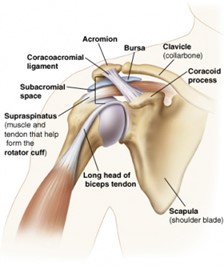
Subacromial Space: The subacromial space is the area beneath the acromion, housing the rotator cuff tendons (supraspinatus, infraspinatus, teres minor, and subscapularis) and the subacromial bursa. Impingement occurs when these structures become compressed or irritated during overhead movements.
Acromion: The acromion is a bony projection of the scapula that forms the roof of the shoulder joint. Variations in acromial structure, such as a hooked acromion or a downward-sloping acromion, can contribute to impingement by narrowing the subacromial space.
Rotator Cuff: The rotator cuff is a group of four muscles and their tendons that stabilise the shoulder joint and facilitate movement. The supraspinatus tendon is particularly susceptible to impingement due to its location within the subacromial space.
Scapula: The scapula, or shoulder blade, provides attachment points for several muscles involved in shoulder movement and stability. Scapular winging, or abnormal scapular movement, can contribute to SAPS by altering the position of the acromion relative to the humeral head.
Treatment Options and Exercise Program:
Treatment for SAPS aims to alleviate pain, restore function, and address underlying causes. It typically involves a combination of conservative measures such as following a rehab exercise program, using holistic measures such as ice and heat, resting and physical therapy.
For example, recently I had a patient who was an avid gym go-er for the past 8 years who had recently developed shoulder pain when doing the shoulder press and bench press. After a thorough objective assessment we narrowed it down to SAPS which was most likely caused by rotator cuff weakness and tightness in the surrounding muscles of the shoulder. I designed him a personalised exercise program focusing on strengthening the rotator cuff within the planes of movement involved in the pressing motions, that he could easily fit into his gym routine. We also did weekly sessions of physical therapy for 4 weeks and after, he reported a significant improvement in pain and range of motion, allowing him to hit his previous record on his pressing movements at the gym after the 4 weeks.
This is one of many patients that I have had where I have managed to help them reduce their pain in the shoulder and increase their range of motion allowing them to return to their hobby with less issues.
What does the research say?
Several studies have been done to investigate the effectiveness of the treatment methods mentioned above in individuals with SAPS. A recent systematic review, which looked at 64 high-quality randomised controlled trials, published in the British Journal of Sports Medicine in 2016 found that exercise therapy should be the first line of treatment to improve pain, function and range of motion in individuals with SAPS and the use of manual therapy may accelerate function and reduction of pain in the short term.
Another systematic review done in 2015, looked at over 4800 articles investigating the efficacy of exercise therapy in the management of SAPS. It found that progressive shoulder strengthening and stretching can be effective and, in low-grade SAPS, it can even be as effective as receiving a corticosteroid injection in the shoulder.
In 2023, a study was done to compare the effects of manual therapy to therapeutic exercise in managing symptoms of SAPS. It included 60 patients and measured the outcome after 1 month of their chosen treatment method. It found that both manual therapy and exercise are as effective as each other in reducing pain, disability and increasing range of motion.
Summary
To summarise, SAPS is a complex condition that can arise from various factors. Understanding its causes and anatomy, including engaging with tailored exercise programs coupled with manual therapy from a qualified healthcare professional, is crucial for effective management.
If you’ve experienced any of these symptoms, come visit us at Bodylogics to get expert insight into your injury.
References
Diercks, R. et al. (2014) Guideline for diagnosis and treatment of subacromial pain syndrome, Taylor & Francis Online. Available at: https://www.tandfonline.com/doi/full/10.3109/17453674.2014.920991 (Accessed: 25 March 2024).
Tauqeer, S., Arooj, A. & Shakeel, H. Effects of manual therapy in addition to stretching and strengthening exercises to improve scapular range of motion, functional capacity and pain in patients with shoulder impingement syndrome: a randomized controlled trial. BMC Musculoskelet Disord 25, 192 (2024). https://doi.org/10.1186/s12891-024-07294-4
Hodgets, C. and Walker, B. (2021) Epidemiology, common diagnoses, treatments and prognosis of shoulder pain: A narrative review. International Journal of Osteopathic Medicine 42, 11-19.
Almalki, Mohammad Abdullah1; Alzahrani, Mohammed Talal2,; Aljulaihim, Abdulmalek Abdulrahman3; Aseeri, Ali Mohammed Mofareh1; Alshehri, Mohammed Abdullah4; Abuhaimed, Mohammed Khalid5; Masuadi, Emad5. Prevalence of shoulder pain and disability in young Saudi bodybuilders, Riyadh, Saudi Arabia. Saudi Journal of Sports Medicine 22(1):p 38-43, Jan–Apr 2022. | DOI: 10.4103/sjsm.sjsm_31_21
aik MN, Alburquerque-Sendín F, Moreira RFC, et al
Effectiveness of physical therapy treatment of clearly defined subacromial pain: a systematic review of randomised controlled trials
British Journal of Sports Medicine 2016;50:1124-1134.
Azin, Z. et al. (2023) ‘Comparison of manual therapy technique to therapeutic exercise in the treatment of patients with subacromial impingement syndrome: A randomized clinical trial’, Journal of Manipulative and Physiological Therapeutics, 46(2), pp. 98–108. doi:10.1016/j.jmpt.2023.06.002.
Abdulla, S.Y. et al. (2015) ‘Is exercise effective for the management of subacromial impingement syndrome and other soft tissue injuries of the shoulder? A systematic review by the Ontario Protocol for Traffic Injury Management (OPTIMA) collaboration’, Manual Therapy, 20(5), pp. 646–656. doi:10.1016/j.math.2015.03.013.