Blog post produced and written by Sports Injury Specialist and Physiotherapist Haroon Ahmer.
Do you ever wake up with a sore, stiff neck that feels like it just won’t loosen up?
You’re not alone. Many people experience this discomfort, often accompanied by tension in the upper traps (commonly mistaken to be called shoulders).
What are the structures involved in a stiff neck?
To help us understand, let’s start with a quick anatomy breakdown. Your cervical spine, or neck, is made up of seven vertebrae stacked on top of each other. Between each vertebra are intervertebral discs, providing cushioning and flexibility.

Have a look at the image. See how the muscles are intertwined around the neck and attach to different important points on the body. The sternocleidomastoid (SCM) travels around the neck and attaches to the clavicle (collarbone). The upper trapezius muscles are large, triangular muscles that run from the base of your skull down to your shoulder blades. They help with neck movement and shoulder stabilisation. Because of the course of the upper traps, it is possible to feel achiness in them when actually the issue stems from the neck. Other key muscles include the levator scapulae and scalene muscles which are largely responsible for rotation of the neck (looking left and right) and also side flexion (tilting your head to the side).
What can cause this to happen?
Below is a summarised list of all the different causal factors that can contribute to a stiff neck and achiness in the upper traps.
1. Poor Posture: Sitting or standing with rounded shoulders and a forward head posture can strain the muscles of the neck and upper back, leading to stiffness and discomfort. Some articles report that for every inch you move your head forward, the weight of your head can increase by up to 4.5kg!
2. Muscle Tension: Stress, overuse, or repetitive movements can cause the muscles in your neck and upper traps to become tight and sore. Let’s clamp down on the term overuse – some people think this means when you overtrain the muscle however this is not entirely correct. It can also arise from other ways. For example, a common muscle to become tense around the neck is the sternocleidomastoid (SCM). When people are lying down watching TV with their heads propped up with a pillow or when they’re in bed on their phones, again, with their heads propped up on a pillow, this can cause the SCM to be in a shortened position for a long period of time leading to muscle tension and sensitive points in the muscle itself.
3. Sleeping Position: Sleeping with your neck in an awkward position or on an unsupportive pillow can contribute to stiffness and pain upon waking.
4. Injury or Trauma: Whiplash from a car accident, sports injury, or a fall can result in muscle strain and stiffness in the neck and upper back.
5. Degenerative Changes: Conditions like osteoarthritis or cervical spondylosis can cause wear and tear on the cervical spine, leading to stiffness and reduced mobility.
I now know the causes – How do I fix it?
If you’re dealing with a stiff neck and tight upper traps, there are several strategies you can try to find relief:
Stretching: Gentle stretching exercises targeting the neck, upper traps, and shoulders can help relieve tension and improve flexibility. Slowly tilt your head from side to side, gently roll your shoulders, and perform chin tucks to stretch the muscles. Don’t forget to stretch the neck in all planes and to hold each stretch for at least 30 seconds as research shows this is the ideal time for the maximum benefit. Only perform up to 4 reps as research has also shown that anything more than this has no effect on muscle elongation.
Heat Therapy: Applying a heating pad or warm towel to the neck and upper back can help relax tense muscles and increase blood flow to the area.
Posture Correction: Pay attention to your posture throughout the day, and make adjustments to maintain proper alignment. Sit up straight, keep your shoulders relaxed, and avoid slouching.
Massage Therapy: Professional massage or self-massage techniques can help release tight muscles and reduce stiffness in the neck and upper traps.
Physical Therapy: A physiotherapist can provide personalised exercises and techniques to address muscle imbalances, improve mobility, and reduce pain.
Ergonomic Adjustments: Evaluate your workspace and make ergonomic changes to reduce strain on your neck and upper back. Adjust your chair height, position your computer monitor at eye level, and use a supportive chair and keyboard.
What does the research say?
A meta-analysis was conducted in 2023 investigating the effectiveness of myofascial release on pain and range of motion in individuals with chronic neck pain. It looked at 10 randomised controlled trials with a total of 549 participants. It found that myofascial release showed a significant difference in a increasing range of motion specifically on side flexion and rotation of the neck. However, it did state that more research needs to be done to corroborate the findings.
Another study was done in 2017 by the Korean Academy of Physical Therapy Rehabilitation Science looking at the efficacy of stretching, massage and muscle energy techniques on range of motion in adults with neck pain. It found that all the methods were effective therefore it’s recommended to combine these various methods when looking to increase range of motion in adults with neck pain. However, the study only included 30 participants therefore more research with larger sample sizes needs to be done to confirm these findings.
Real Life Example
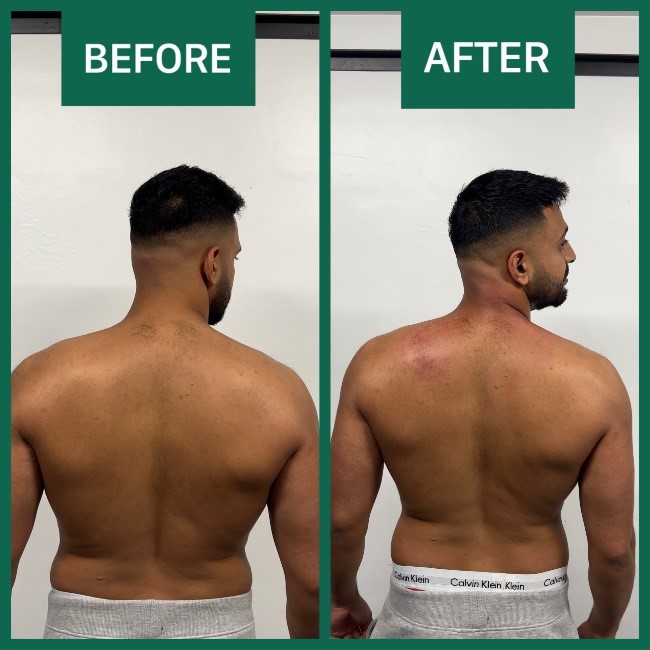
I had a patient who worked a desk-based job for a bank. He complained of stiffness, achiness in his upper traps, reduced range of motion and felt like his neck was “stuck”. He would regularly go to the gym for weight training however never did any mobility work or cardio. As you can see in the image below, he has reduced range of motion in his neck and you can’t see his nose. After the treatment his range of motion had increased significantly. As evident from the image below, you can now see his nose and more of his face. The patient also reported feeling looser and “it’s as if I have a new neck”. It’s important to know that although there is great benefit in manual therapy, the results are often temporary. Therefore, it is imperative to perform strengthening and stretching exercises to maintain results.
When to Seek Help?
While occasional stiffness and discomfort in the neck and upper traps are common, persistent or severe pain may indicate an underlying issue that requires medical attention. If you experience numbness, tingling, weakness, or shooting pain radiating down your arms, it’s essential to see a healthcare professional for a thorough evaluation and appropriate treatment.
Don’t let a stiff neck and tight upper traps hold you back from enjoying life to the fullest. By understanding the causes of your discomfort and implementing effective strategies for relief, you can take proactive steps towards better neck health and improved overall well-being.
If you suffer from any of these symptoms, head over to our online booking portal and get yourself an appointment with our specialists who can help you on your journey to get a looser neck.
References
Kate Starling (2016) The 42 Pound Head, Physio Falmouth Plus. Available at: https://physiofalmouthplus.co.uk/42-pound-head/#:~:text=For%20every%20inch%20you%20move (Accessed: 2 April 2024).
Page P. Current concepts in muscle stretching for exercise and rehabilitation. Int J Sports Phys Ther. 2012 Feb;7(1):109-19. PMID: 22319684; PMCID: PMC3273886.
Missaghi B. Sternocleidomastoid syndrome: a case study. J Can Chiropr Assoc. 2004 Sep;48(3):201-5. PMID: 17549118; PMCID: PMC1769463.
Overmann, L., Schleip, R., Anheyer, D., & Michalak, J. (2023). Effectiveness of Myofascial Release for Adults with Chronic Neck Pain: A Meta-Analysis. Physiotherapy. https://doi.org/10.1016/j.physio.2023.12.002
Jeong, H.M., Shim, J.-H. and Suh, HR (2017) “The passive stretching, massage, and muscle energy technique effects on range of motion, strength, and pressure pain threshold in musculoskeletal neck pain of young adults,” Physical Therapy Rehabilitation Science . Physical Therapy Rehabilitation Science. doi: 10.14474/ptrs.2017.6.4.196.