Blog post produced and written by Clinic Manager and Sports Injury Specialist Jason Dodd.
This week we wanted to share with you a graph taken from a research paper looking at the best ways to avoid injury. When we think of injury avoidance, many of us automatically think of stretching (and our lack of it!). Whilst stretching has some benefits, it has been shown in various studies to have little to no effect on reducing your likelihood of injury. This study in the British Journal of Sports Medicine is a great paper which highlights this fact.
Many ask us ‘well why are we taught this then?’ It’s a really good question and it is most likely based on our previous research and understanding BUT it is important to understand that science and research methods/protocols have evolved considerably over the years and we are much better at testing and recoding data than we were 30-40 years ago. The theory of stretching is also quite simple and easy to understand and requires relatively little commitment to conduct and perform, making it much easier for us to digest and incorporate into a daily routine.
However, the key to injury avoidance and prevention is all in the ability to manage and control load. This is easier said than done! To improve fitness and performance, we need to ensure we challenge our body sufficiently to make adaptations so we are better able to meet the demands of our environment or to meet our set goals. But when we push ourselves too much we can end up injured.
This is where our graphic illustration comes in which can help to explain the principle of progression and progressive overload. The graph shows/indicates the risk of injury occurrence when we increase our load. As you can see, as the load/volume increases each week, the likelihood of injury also increases. From this particular piece of research it is evident that the ‘magic’ number is no greater increase than 10% of your volume each week. From the graph you can see that a 15% increase in load can actually DOUBLE your likelihood of getting injured! It is amazing how these small margins can lead to such a heightened increase.
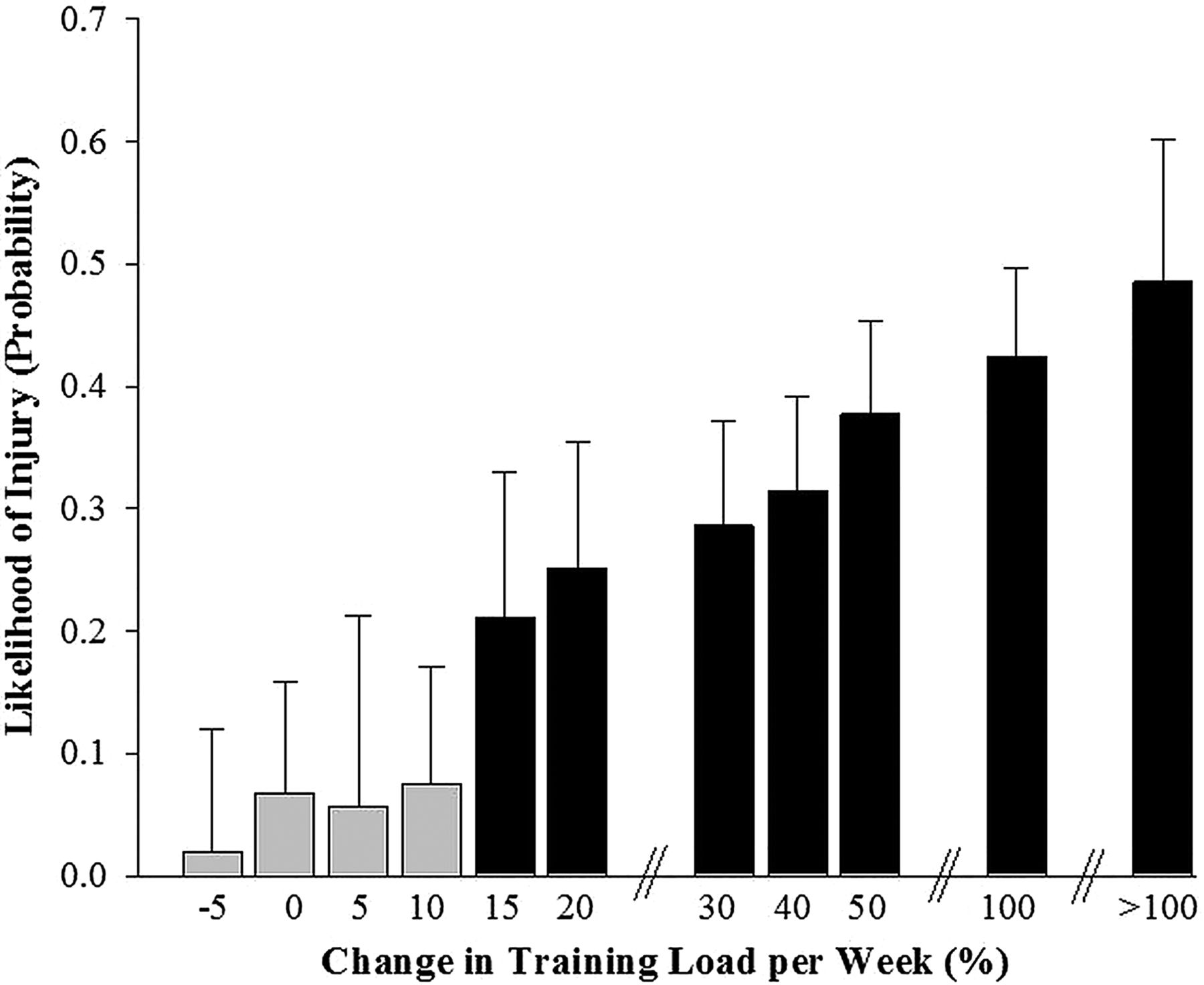
Now, as with anything, there are always exceptions, and you can criticise this in a number of ways, such as the fact some people increase load by far greater numbers than stated here and do not get injured, and also the fact that if an elite marathon runner who runs an average of 150 miles per week (typically), if they increased their load by 10% every week, within the space of 6 weeks they would be running a total of 267 miles per week, which just isn’t going to happen!
Likewise, your novice runner who has started off running 4-5 miles per week, an increase of 10% per week would take them a couple of months to get to 10 miles in one week. So the theory has some flaws. But from a general injury prevention protocol it holds some great substance to help people plan their training better to stay injury free for longer.
So whilst injury prevention can never have a magic formula, there certainly are some things we can look at as key indicators as to how best to prevent injury. If you can manage and control your load then you are going to be doing a very good job at reducing your likelihood of injury.