Blog post produced and written by Clinic Manager and Lead Sports Massage Therapist Jason Dodd on a relatively unknown medical condition called The Female Athlete Triad.
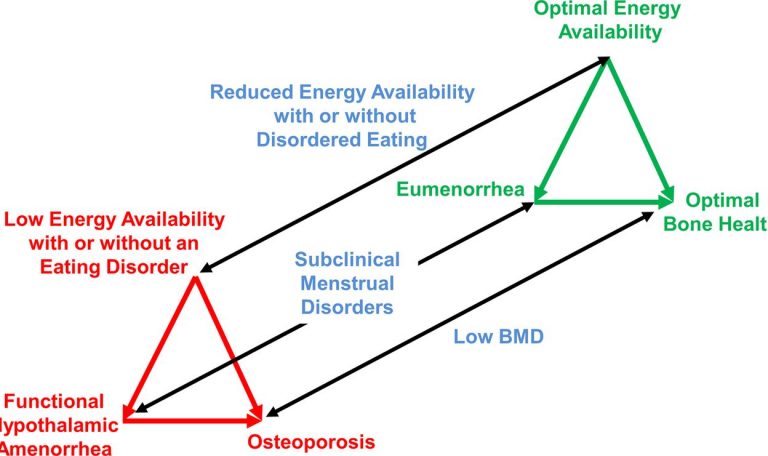
This medical term may be something unknown to most of us. It was for me until I came across my first instance of it which motivated me to find out more about this medical condition. That’s correct; it is a medical condition which consists of the following 3 symptoms;
1) low energy availability with or without disordered eating,
2) menstrual dysfunction
3) low bone density
The aim of this blog is to give a brief overview of the condition to make all female athletes, competitors and health enthusiasts aware of the signs and symptoms and why it can be an issue for you.
Let’s start off by looking at point number one from above. Low energy availability is effectively a mis-match between the energy needed/expended for exercise against the athlete’s energy intake through their diet. There are certain formulas which can be used to work out what an athlete’s optimal dietary intake should be for healthy physiological function and more on this can be found here in this article by the International Olympic Committee https://bjsm.bmj.com/content/52/11/687
Whilst these formulas are useful in helping to gain an understanding of what consists of healthy intake, it does have its limitations. First, there are no current protocols for precise accurate measuring, the formulas that you will find are all based on ‘guesstimates’ as opposed to factual and research backed evidence. It is also hard to keep honest food/energy intake diaries and then you have the difficulty of training peaks and being able to adjust dietary requirements accordingly.
Of particular importance is the women’s menstrual cycle. It is often something I have failed to ask about when treating injuries but something I can now comfortably ask about as I find out more and more about this topic. The female menstrual cycle has a huge impact on the training regime of any athlete. For example, in a study on female athletes and ACL injuries in soccer, it was found that women are much more likely to injure their ACL during the final phase of their menstrual cycle compared to men. The reason for this is due to the hormone relaxin being reduced which is essential for child birth but has the role of creating laxity within ligaments. Laxity in the ligaments means less tension and less tension usually results in less strength. The results of this tend to be injury. It has also been noted that severe energy deficiency in females has been known to lead to disturbances in the female menstrual cycle.
Finally, bone health is often affected by low energy availability. This then leads the female athlete to be at a higher risk of things such as stress fractures which can disrupt and ruin an athlete’s season. Even short term energy deficiencies have been shown to negatively affect bone turnover in women compared to men. The most at risk population here are those who take part in running, swimming and cycling, due to the endurance based characteristics of the sport which we normally associate it with.
It is worth mentioning here the psychological aspects of lower energy availability. It has been proven that those who seek ‘thinness’ have a much higher chance of falling victim to the female athlete triad. It has also been found that those suffering from low energy availability have higher incidences of mild depressive traits, psychosomatic disorders and a decreased ability to manage stress.
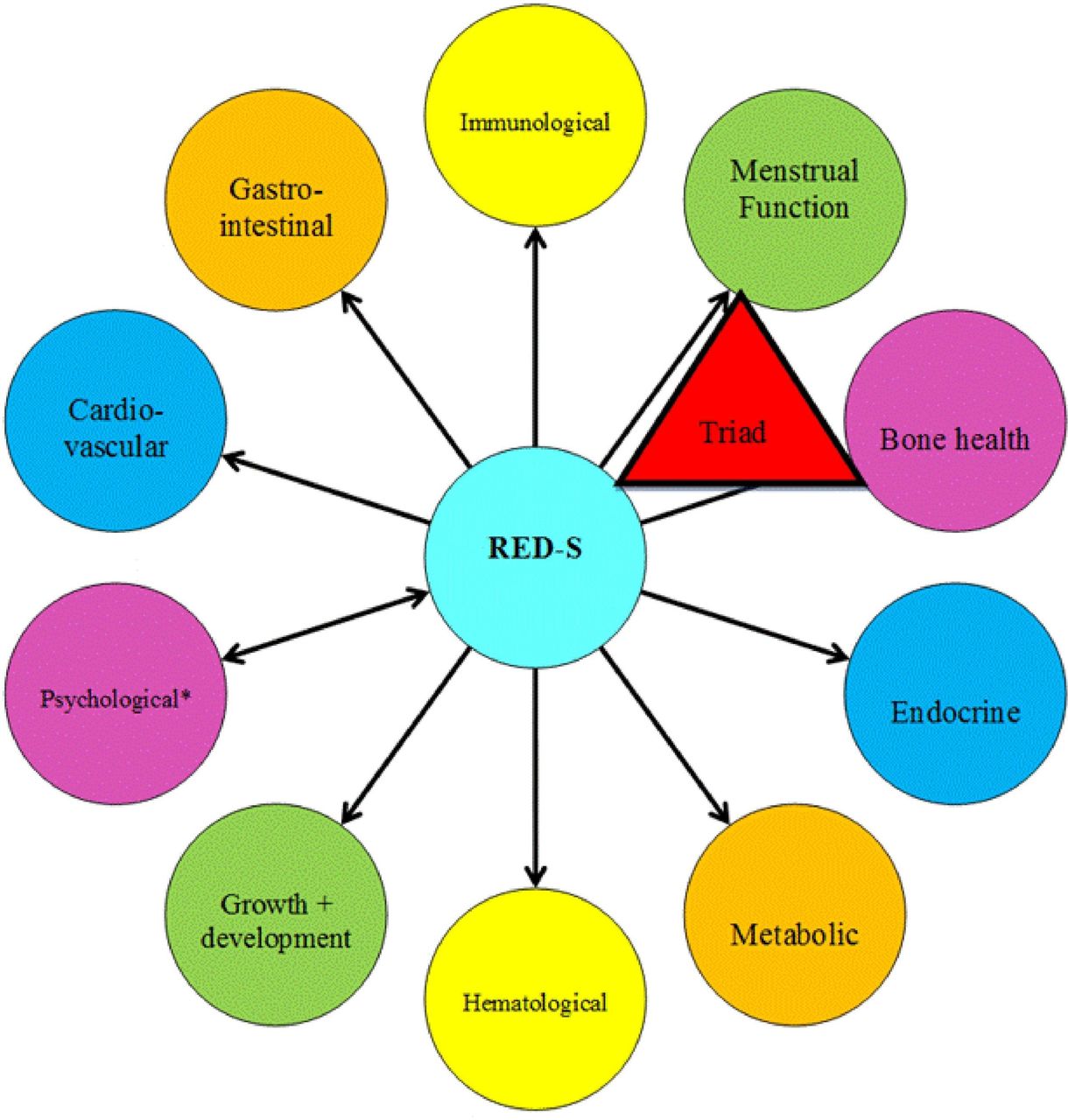
The images below show the relationship between the Female Athlete Triad and the RED’S checker.


Whilst what we have mentioned so far focuses on the female athlete, recently the term RED’S (Relative Energy Deficiency in Sport) has been developed. This applies to both men and women and takes the female athlete triad one step further by looking a much broader range of factors which can affect sporting performance.
Both the prevention and screening for athletes who may be at risk are obviously very hard to do. A degree of privacy is expected in everyone’s life and some people can find certain questions very intrusive and wonder why on earth they are being asked them. A very good place to start is by ensuring people know what the symptoms are and that they are able to reach out for help to better understand what is happening with their own bodies.
It is somewhat vital though that this condition is identified very early on. Studies show that things such as Osteoporosis are not a result of sudden degeneration of bones at an older age but instead as a result of poor oestrogen levels at a young age (which is affected by poor menstrual health) resulting in the failure to obtain optimal bone mineral density in childhood and adolescent. Therefore, the identification and treatment of this condition is essential in the younger athlete.
There is much more to find out about the long term effects of the female athlete triad and the RED’S condition and the research and education is on-going but for now, as an athlete, male or female, it is important to begin to understand the risks and signs of both conditions in the hope we can help each other out more and start to make us healthier and better competitors.