Blog post produced and written by Clinic Manager and Lead Sports Massage Therapist Jason Dodd. Jason follows up on our Osteopath Joe Cattons excellent blog on Rotator Cuff injuries with a ground breaking study which looked at the effects (OR LACK OF!!) shoulder surgery for impingement conditions. Get ready to throw out everything you may have ever believed!!
During the past three decades, clinicians and patients with subacromial shoulder pain have accepted minimally invasive arthroscopic subacromial decompression surgery in the belief that it provides reliable relief of symptoms at low risk of adverse events and complications.
However, the findings from a recent study suggest that shoulder surgery might not provide clinically significant benefit, bringing into question the whole point of conducting shoulder surgery at all!
This statement and study will raise a few eyebrows and ruffle a few feathers. Shoulder pain is common and poses a substantial burden to society. It is estimated that 2-4% of all primary care visits in the UK are as a result of shoulder pain. Of these visits, it is further estimated that 70% of them are as a result of Sub-Acromial pain.
Subacromial decompression (surgical intervention) was introduced in 1972 as a treatment for subacromial shoulder pain without high-level evidence and is now one of the most common surgical procedures in orthopaedics. The rationale is that the shoulder pain is caused by physical contact during arm movement between the rotator cuff tendons and a spur of bone or associated soft tissue projecting from the acromion of the scapula, and that surgical removal of the bone spur and soft tissue (decompression) eliminates this contact and, thereby cures or reduces symptoms.
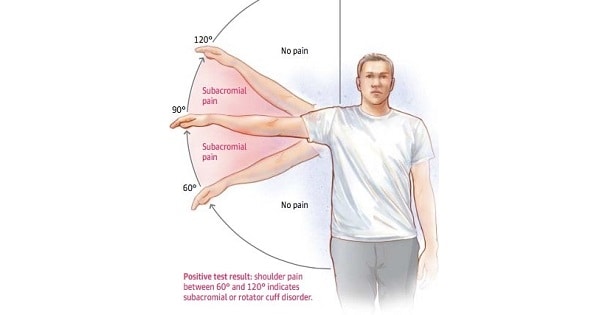
An anatomical cause for subacromial pain has been proposed, whereby mechanical contact occurs between the rotator cuff tendons and the overlying acromion or bone spur that often forms at the antero-inferior margin of the acromion, narrowing the subacromial space. The narrowing makes physical contact more likely, particularly in certain positions of the arm (known as a painful arc, see image above). The condition is sometimes referred to as impingement. Although many patients with subacromial pain are treated with, and will respond to, non-operative treatment alone, surgical intervention is often used as an early treatment choice or in challenging/persistent cases. This intervention involves decompressing the subacromial space by removing the bone spur and any involved soft tissue arthroscopically, a procedure known as arthroscopic subacromial decompression.

The number of patients undergoing subacromial decompression in England (UK) rose by seven times from 2523 in 2000 to a huge 21,355 in 2010
In a ground breaking study by Beard, et al, 2015, between Sept 14, 2012, and June 16, 2015, 313 patients were randomly assigned to treatment: 106 to decompression surgery, 103 to arthroscopy only (this can best be explained as key hole surgery but this form does not involve any surgery per se, this method just explores the area inside the shoulder area and does not perform any actual surgery), and 104 to no treatment.
The results proved fascinating, the decompression (surgical) and arthroscopy only (placebo) groups considered themselves to have improved more after treatment than in the no-treatment group at 6 months, although at the 12 month mark there was no significant difference in pain between all the groups (surgery, sham surgery and no intervention).
See the images below for the results. It is pretty astonishing!!
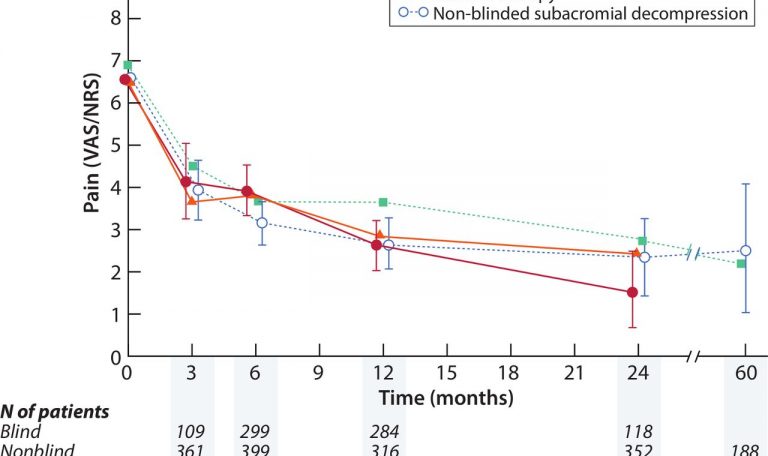
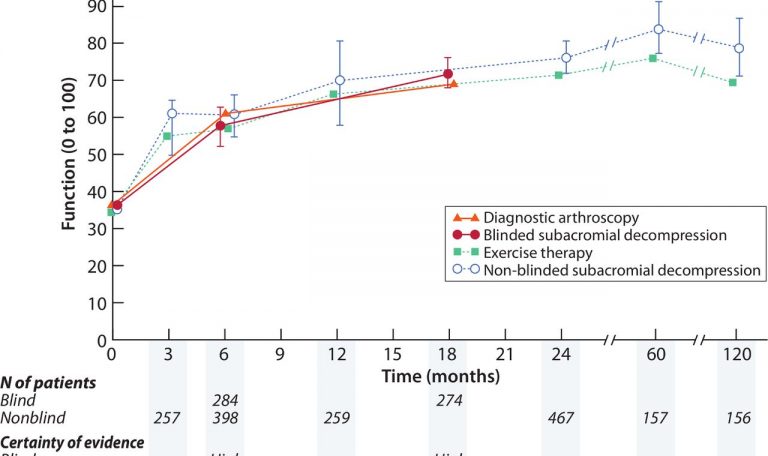
The question that arises here though is ‘well how can they have the same perceived wellness as each other when one has had surgery and the other has nothing?’. This is where we begin to realise that there is more to pain and restricted movement than the biological and mechanical make up of our body. One argument is that as a result of the ‘surgical intervention’ studies are much more compliant with their rehabilitation. This poses the question though that had they just done this intensive rehabilitation in the first place, their symptoms and pain would probably have improved. Both groups in this study followed a strict rehabilitation programme after their ‘surgical intervention’.
Another case for improvement scores is subjects perceived or expected outcomes. It has been shown before (study) that patients expectations heavily influence success of an intervention. Our beliefs and experiences (which may be built on previous episodes or from social influences) can have huge positive effects on us.
In conclusion, shoulder surgery for subacromial decompression is no better than placebo. It may be suggested that a thorough and robust rehabilitation programme is the new ‘gold standard’ of shoulder pain, especially for those which would fall under the ‘impingement’ heading/category.
References