Blog post produced and written by Clinic Manager and Sports Injury Specialist Jason Dodd.
It is almost inevitable that we will all, at some stage, suffer from back pain (both lower and upper). But when an episode occurs, how do we best manage it and, even more so, how do we best avoid it happening again? These are common questions I get asked all the time, so I thought I would share my experience and understanding of the research with you.
To begin with, it is known that only 5% of all back pain is a result of serious pathology. For the purpose of this blog, I am not going to focus on that particular portion as it is unlikely/rare to effect the vast majority of us and I want this information to be accessible and relevant to many of us.
To treat this 5% requires very specific intervention with specific imaging modalities to assist and aiming to summarise this in a blog post would be too difficult. If you would like further reading on this though then please do contact me and I can send over various research/gold standard practice articles for you to read.
When working with the remaining 95%, of who have back pain, the guidance starts to get a lot ‘less specific’. Now this may sound like its dismissive of people’s pain and function, but research is showing us more and more that one intervention is not necessarily the answer to everything. Let’s take ‘lifting technique’ for example. For over 30 years, there has been guidance, and health and safety warnings, on how to lift. We have all seen the information where it says ‘lift with a straight back, squat down, etc…..’ BUT, the incidence of lower back pain is at an all-time high and more and more people are having time off work due to lower back pain. And think about it too, we live in a society now where many of us have more desk based jobs as opposed to manual labour (of course this does not apply to everyone here) yet our incidence of back pain is higher than ever. This leads us to ask the question ‘has this intervention made any difference at all’? One could argue that it is due to people not listening to the advice, yes, but what if it is that the advice just doesn’t really matter at all and it is completely unrelated to helping to solve back pain. Studies have shown, multiple times, that ‘correct lifting’ technique is not associated with lower incidence of back pain. So if that is not the answer then what is?
This is the question we are currently seeking the answer to. We have yet to find it and if I am honest, I do not think we will find the answer in the near future. I also believe that there is no direct answer, it is a combination of variables that all lead to the incidence occurring.
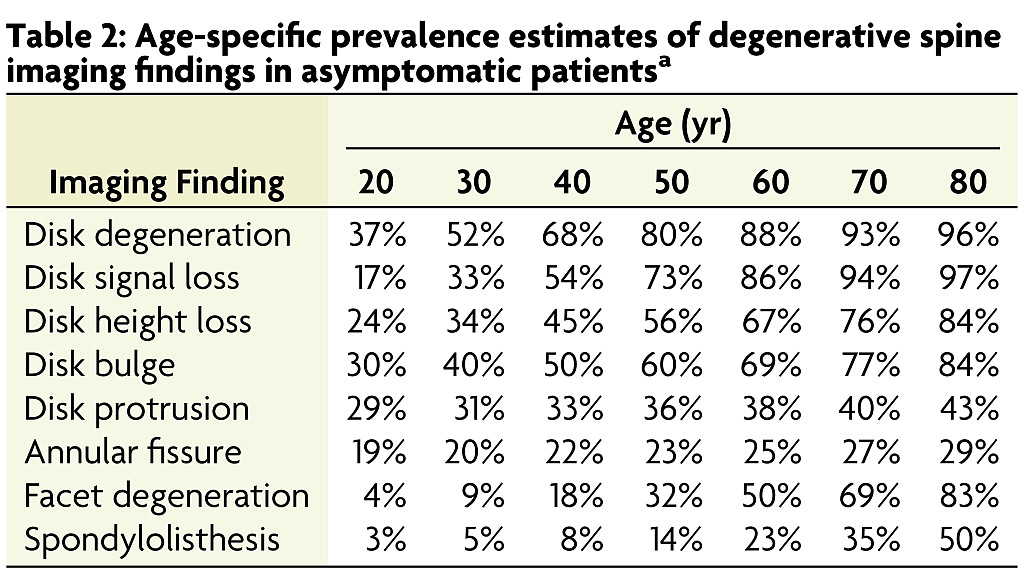
So if we were to say that there is no direct cause then how can we best manage it? At this point I will now stress that I do not think we should dismiss everything we already know, and I will give an example here. I see many people with MRI’s of their back which show changes at the spinal cord level. Whilst it is easy to correlate these changes with the pain the patient feels, it is not always as black and white as that. A study in 2015 showed the normal findings of MRI scans in people who were asymptomatic. This meant the people scanned HAD NO PAIN – yet when you look at the findings, they all showed what were termed as ‘normal changes’. Look at the data for those who were in their 40’s and had disc degeneration – 68%!! And then those in their 50’s it went to 80%!! Remember, none of these had ANY pain. So it does lead us to ask the question, how relevant are the scans and how does it affect our intervention?
As research has grown, we have become much more aware of how our beliefs and experiences shape our future behaviour. This can then have an impact on how we process and manage pain. If we experience pain, we obviously want to avoid it. So we adopt different movement strategies to avoid the thing that causes us the pain. This can then lead to other issues developing such as abnormal movement patterns, which our body is not used to and this puts stress and strain on areas which are not prepared, thus leading to potential for pain to occur.
The reasons for how this pain occurs are complex and far reaching. Again, in the space of a blog post here I do not feel I would give it justice if I attempted to do this. But, what I can say about pain is that it is usually simply our own body’s protection device. We now know that increased pain does not mean increased tissue damage (again, use the example shown in the table with ‘normal’ spinal changes’). So with this knowledge, how can we best approach our lower back pain?
First, and this sounds obvious, we need to start with avoiding the one thing that creates our pain in the first instance. This may mean less bending forwards, or bending backwards, depending on the one that hurts the most. This is so we can get the system moving and not lose too much function. The simplest way to look at this is, if you do nothing then your body will get used to this ‘new normal’. However, when you come to then move the system (as we would do in everyday life) you may find that your system reacts poorly to what it believes is a ‘threat’ (remember, it has got used to doing nothing, so a new stress on the body may cause it to react badly). So finding ways in which you can move is important.
The next stage is trying to maintain strength. There is no direct correlation between core strength and back pain. I know that will sound hugely controversial, BUT, did you know that one of the highest populations of people with low back pain is in fact elite athletes. Now, try telling them that their ‘core is weak’. Again, we cannot correlate this belief with the data we have so it is important to understand that building core strength does not necessarily mean you will not get back pain. That being said, working on developing your core strength will certainly help but it isn’t only because your core strength is increasing, its more than likely that you are stressing the body in ways which enables it to adapt to its current condition (again, go back to the table about spinal changes). If you can get used to moving in these new ways then you can begin to overcome the pain you may feel.
So if I am saying that core exercises are not necessarily the key, then what is? Well this is the main point of this post, exercise in general is essential for helping with back pain. There is no magic cure, each patient has to have an individual programme set for them based on their needs. If it were that easy I would just say ‘g on youtube and type in exercise for back pain’ and if this were so successful then there would never be back pain ever again and the situation would be solved! Obviously this is not the case, so being more specific with your approach is key.
To summarise, back pain is very common and will continue to be for a long time yet. The aim is to ensure you see someone as soon as you can if you are suffering so you can get a specific plan to suit your needs. However, often the best tactic is prevention rather than cure. So if you are not suffering from low back pain at the moment, then use this opportunity to get your body moving as much as possible to help reduce the chances of back pain developing.
If you are suffering from back pain then come and see one of our specialists who can help fast track your recovery and get you back on the pathway to success. Contact us now and book in to see one of our highly trained medical professionals who can assist with your performance and injury plan.