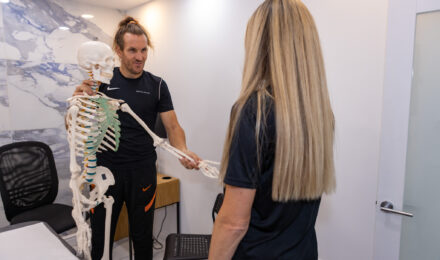

Blog post produced and written by Clinic Manager and Sports Injury Specialist Jason Dodd.
Many of us may know someone who has a degenerative meniscus. But what does this mean? The meniscus acts as a shock absorber between your thigh bone and your shin bone. It basically stops the two bones colliding together. It also helps keep the movement relatively friction free, which is great for movement mechanics.
However, when we get knee pain, it can sometimes be attributed to this structure. Often, surgery is the first thing stated and then the patient is left wondering when it will happen. But what if I told you that surgery may actually be wrong? I want to share with you the facts and the research so you can make informed decisions later in life (or now if you are suffering from pain).
A study in 2015 showed that those who underwent surgery to remove some of the meniscus, vs those who were led to believe they had some of their meniscus removed (placebo surgery), had identical progress outcomes at the 2 year follow up (the same amount of people who did well was equal in both groups). The conclusion from this paper was that there is no evidence for surgical management of degenerative meniscus tears.
And another study carried out an MRI scan of 230 knees of healthy individuals, all who had no knee pain. And the authors found that 97% of all knees scanned, showed some biological changes in their knee (including meniscus tears and osteoarthritis). Remember, all these findings were in people who do not have pain!
So the question is then – what should you do? And does structural damage always mean you should expect pain?
It is important to note here, we do not have conclusive answers. We believe that some things may be more beneficial than others, but ultimately we cannot say for sure who would benefit from what every time. This is why following the random information on YouTube which states ‘the best exercise for meniscus tears’ is really unwise. What works for you may not work for someone else. Sometimes these YouTube videos can be excellent, especially for genera exercise ideas in the absence of injuries, but with certain pathologies it is vital you address it with the correct intervention to prevent the situation getting worse.
For example, I will allow some individuals to perform running drills with a meniscus tear whilst others I will prevent from doing this. It is not a flip of the coin moment which decides either, the patients history and presenting condition will determine a lot of things which will help decide what pathway is best to take with them. It is almost impossible for two different people to ave the exact same intervention plan…..and that is what YouTube is doing. So think carefully before doing the things on there before self-administering.
As a general rule of thumb though (which sounds ironic after my last point), a good strength programme suited to the individual and an understanding of mechanics and joint loads, will be a good place to start. You may find that there is a lot of relief from the use of soft tissue work and stretching alongside this, but the evidence for this is limited. Patients do often report feeling better after though, which may then enable them to go and perform the exercises prescribed after.
Ultimately, the key to success here is an individualised programme which helps address the current issue, without flaring symptoms. Unfortunately, the wait and see approach often ends in disaster. Patients may feel better after a period of rest but as soon as they come to do anything on the knee again it brings back all the pain, and often worse. This is likely due to the deterioration of leg strength due to unloading of it, which when asked to start doing more work, creates pain and discomfort. This can then lead to other comorbidities as people tend to do less exercise when they are in pain. All this can be avoided if you see a healthcare professional to help you understand the pathology and begin to work on a plan.
So if you are affected by this then start working with a healthcare professional, ask as many questions as you can and sort a plan that suits your needs and gets you back to where you want to be.
Contact us now and book in to see one of our highly trained medical professionals who can assist with your performance and injury plan.