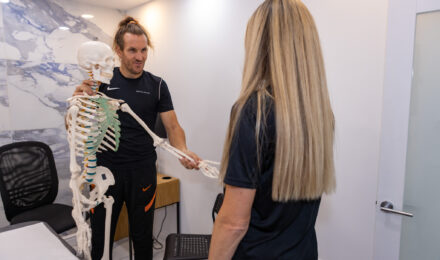
Blog written and produced by Monika Smiechowska – Sports Therapist and Injury Rehabilitation specialist.
Let’s first establish what an ankle sprain is – the ankle joint can sprain in several different ways; however, it most commonly occurs when the ankle plantar flexes (toes pointed) and inverts (turns in). The sprain happens as the ligaments, that join bone to bone, stretch causing inflammation, pain, swelling, bruising and consequently joint instability. In more complex cases, the ankle sprain can also be accompanied by a fracture or dislocation – this usually happens because of the increased load to the tibia and fibular (bones within the lower leg).
Lateral ankle sprains are the most prevalent neuro-musculoskeletal injury in general and amongst physically active individuals. They can often lead to chronic ankle instability, in fact a study by Gribble et al (2014) found that between 50 and 70% of people who have suffered with lateral ankle sprain have developed chronic symptoms at the joint. Both clinicians and researchers stress the importance of a good rehabilitation strategy.
Rehabilitation Principles - North London Leading Ankle Injury Specialists
Regular and consistent rehabilitation following any injury is extremely important. An ankle is a joint that allows a lot of range of motion in various different planes – this means the rehabilitation program needs to target all of those in order to return to its optimal function.
Initial rehabilitation should always focus on regaining full range of motion – this is relative to the injured individual, although there always is normative data you can use. A good way of monitoring this is to compare the uninjured side to the injured side. This can be achieved through range of motion exercises as well as hands on work, including mobilisation and soft tissue/scar tissue release.
Following regaining full range of motion, the program should then focus on regaining strength and improving proprioception and balance. This is usually done using a variation of bodyweight and weight loaded exercises.
How do I successfully rehabilitate my ankle?
A successful rehabilitation requires patience from both, the injured individual as well as the therapist.
As ankle sprains are such a common injury, in and out of sporting environments, there is a constant flood of research on this topic, addressing the most effective and up to date treatment methodologies. It is essential that therapists stay up to date with medical research in order to be able to provide their patients with the most effective treatment.
Here at Bodylogics we treat many patients with sprained ankles and other ankle pathologies. If you are struggling with your recovery and wanted to get another opinion then feel free to reach out to us and we will have one of our clinicians assess and offer some advice on how you can improve your pain, whilst at the same time getting some much needed treatment on the affected area.