Joe Catton, registered Osteopath and member of the Barnet Osteopathy Team. Joe takes a look at the Rotator Cuff and helps you to understand what is really happening with your shoulder pain.
Are you suffering with shoulder pain? Is this affecting your everyday movement and sleep? Did you know that shoulder pain affects around 7% of the UK population, increasing to 26% in the elderly, and it can have a very debilitating effect on your quality of life. Shoulder pain is the third most common complaint after low back and neck pain, that osteopaths commonly see.
The shoulder joint is one of the most mobile joints in the body. However, this comes at the cost of stability to allow us to do all the things we are used to doing with our hands like scratching your back, climbing a tree or just brushing your hair. However, this reduced stability means it is more susceptible to injury and there is a wide variety of different causes for shoulder pain. One of the most common sources, is issues with the rotator cuff, which accounts for around two thirds of cases
Good shoulder function is essential to be able to move your arms freely while at work, playing sport, getting dressed, and even reaching for that last tin of baked beans on the top shelf. In this article we will look at the rotator cuff which is made up of four muscles which control the shoulder movements, the symptoms you can experience when its injured, and how we can treat it.
What is the Rotator Cuff?
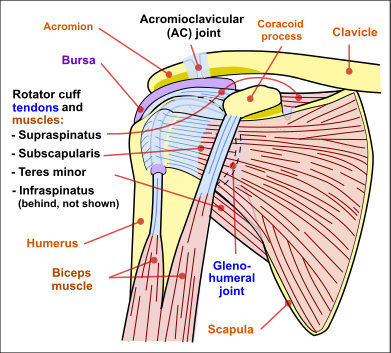
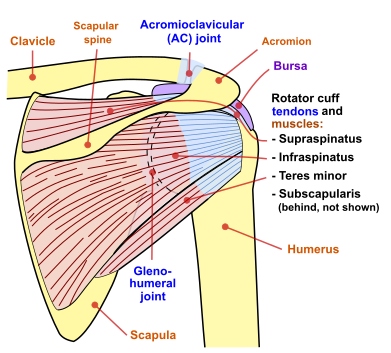
The shoulder joint is a ball and socket joint made up of the shoulder blade known as the scapula and the arm (humerus). There are lots of ligaments and surrounding muscles which include the rotator cuff which helps support and stabilise the shoulder.
The rotator cuff is formed of four muscles and tendons which originate from the scapula and attach to the head of the humerus. They are known as the supraspinatus, infraspinatus, teres minor and the subscapularis. These muscles work together to stabalise and raise your arm, and internally and externally rotate it. The tendons of the muscles, attach the muscles to the bone and help hold the head of the humerus into the socket joint of the shoulder blade.
How does the rotator cuff get injured?
You can injure the rotator cuff through a variety of ways:
- Acute cases can arise from a single trauma such as a fall onto an outstretched arm or lifting something heavy. In these cases, the symptoms and pain will appear quickly.
- Injuries can be due to degenerative changes as we age. There is normally a slow progression of pain.
- Repetitive arm movements as seen with jobs like painting, carpentry and plastering or jobs with overhead arm movements, or certain sports that have repetitive arm movements like tennis or golf. There will usually be a slow progression of pain due to the repetitive actions which gets worse over time.
When there is a slow progression of pain this is normally caused by ‘micro trauma’ which is a small and repeated irritation to the rotator cuff. This can cause inflammation to the area as the body tries to repair itself. As we keep doing the same movements this repetitive cycle of injury and repair can cause a rotator cuff tendinopathy. If this continues without being addressed, over time this can build up and create a partial rotator cuff tear. If this continues eventually it can lead to a complete tear through one or more of the rotator cuff muscles. However, the earlier these issues get addressed the quicker the recovery time to get you back to doing what you like.
Symptoms of rotator cuff injury:
- Pain into the shoulder which can feel like a dull ache
- Reduced range of motion of the shoulder especially raising your hand above your head or reaching behind you.
- Pain or difficulty with overhead activities
- Arm weakness and reduced strength
- Poor sleep due to pain especially if you lie on that shoulder
What can we do about it?
Treatment will initially be focused on reducing pain and any swelling or inflammation, before seeking to return full range of motion to the shoulder, and strengthening the rotator cuff muscles and surrounding musculature.
At the beginning it is important to avoid activities which increase the pain and symptoms you are suffering. A period of rest and ice can help to reduce the pain. Osteopathic treatment can use a variety of techniques such as massage to help warm up and stretch the muscles and increase blood flow to the area to assist with repair. Articulation of the joint to help increase the range of movement in the shoulder. Most importantly we will provide exercises to increase the range of motion in the shoulder, exercises to develop the strength of the rotator cuff and surrounding muscles as well as advice to minimise the chance of reoccurrence.
If you are suffering with shoulder pain or its just a niggle you want to get checked out then do let us know. As osteopaths we will examine and test the different structures in the shoulder, as well as the surrounding areas like the neck and back to be able to diagnose a rotator cuff injury from the many other causes of shoulder pain such as; a bicep tendinopathy, frozen shoulder, neck pain or bursitis. If you have any questions, comments or just want to know more, then please get in touch.